
Transdermal Patch Machine
Transdermal drug delivery has revolutionized the way medications are administered, offering controlled release, improved patient compliance, and reduced systemic side effects. Central to this innovation is the transdermal patch machine — highly specialized equipment that forms the backbone of patch manufacturing. At iControl Technologies, we believe in demystifying these advanced systems so that pharmaceutical professionals, engineers, and stakeholders can fully understand the technology, process flow, and critical quality control measures that ensure patient-safe products.
In this article, we will explore:
- What transdermal patch machines are and why they matter
- Core components and technologies involved
- The production process: from raw materials to finished patch
- Quality control principles and practices
- Compliance with regulatory frameworks
- Innovations shaping the future of transdermal patch manufacturing
1. Understanding Transdermal Patch Machines
1.1 What Is a Transdermal Patch?
A transdermal patch is a medicated adhesive patch placed on the skin that delivers a specific dosage of active pharmaceutical ingredients (APIs) through the skin and into the bloodstream. Unlike oral drugs, patches bypass the digestive system, resulting in:
- Stable therapeutic levels
- Reduced first-pass metabolism
- Increased convenience and compliance
Common transdermal medications include nicotine, hormones, pain relief compounds, and cardiovascular drugs
1.2 What Is a Transdermal Patch Machine?
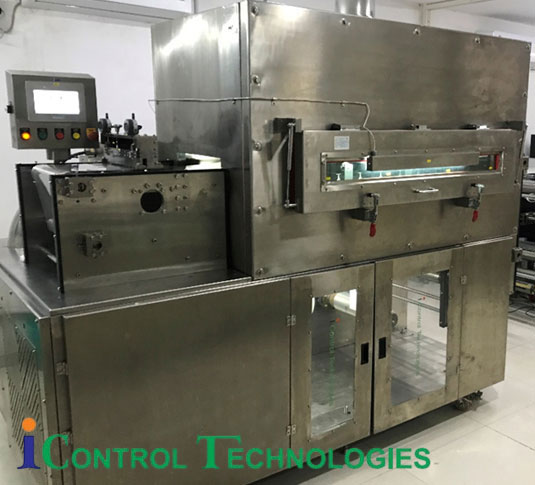
A transdermal patch machine is a specialized manufacturing system designed to produce high-quality transdermal drug delivery patches in a controlled, repeatable, and scalable manner. Rather than a single device, this system typically comprises multiple integrated modules that handle coating, lamination, cutting, dosing, inspection, and packaging.
These machines are engineered with precision and flexibility to accommodate:
- Different drug formulations
- Variable patch sizes and shapes
- Diverse adhesive systems
- High-speed production environments
2. Core Technologies in Transdermal Patch Machines
2.1 Coating Technology
The most fundamental process in patch manufacturing is the application of drug formulation onto a substrate. This is achieved via advanced coating technologies such as:
- Slot-die coating: Highly precise, minimal waste, excellent uniformity
- Gravure coating: Versatile for high-speed environments
- Spray coating: Suitable for thermally sensitive APIs
These systems control:
- Coating thickness
- Flow rates
- Drying profiles
all critical in achieving consistent drug delivery.
2.2 Lamination Systems
Lamination involves combining multiple layers — drug layer, adhesive matrix, backing films, release liners — into a single patch structure. Key lamination technologies include:
- Roll-to-roll lamination: Continuous and scalable
- Hot-melt lamination: Heat-activated bonding
- Cold lamination: Adhesive bonding without heat
Proper lamination ensures integrity, adhesion, and stability of drug layers.
2.3 Precision Cutting and Die-Cutting
Once layers are laminated, patches must be cut into precise geometries. Technologies here often include:
- Rotary die cutting: Fast, continuous, high throughput
- Flatbed die cutting: Flexible for varied designs
- Laser cutting: Extremely high precision for micro-accuracy
Cut quality affects:
- Adhesive exposure
- Patch consistency
- Patient safety
2.4 In-Line Inspection and Vision Systems
Advanced machines feature integrated vision inspection systems that monitor:
- Coating uniformity
- Lamination defects
- Contaminants or particles
- Dimensional accuracy
These systems use AI-driven optical scanning to reject defective units in real time.
2.5 Smart Automation and Control
Modern transdermal patch machines incorporate:
- PLC (Programmable Logic Controller) systems
- SCADA-level monitoring
- Real-time sensors for temperature, pressure, humidity
- Feedback control loops
This level of automation ensures robust control over critical parameters.
3. The Transdermal Patch Manufacturing Process
To appreciate the machine technology, it helps to break down the manufacturing process step-by-step.
3.1 Raw Materials Preparation
Key Inputs:
- Active pharmaceutical ingredient (API)
- Pressure-sensitive adhesive (PSA)
- Backing film
- Release liner
- Solvents or plasticizers
Before entering machinery, formulations must be:
- Measured
- Mixed to homogeneity
- Conditioned (temperature, viscosity)
Quality starts with materials — impurities or variability can compromise the entire batch.
3.2 Coating Stage
Using slot-die, gravure, or spray coaters, the drug adhesive mixture is applied to the substrate with micron-level control over thickness.
Critical parameters:
- Flow rate (ml/min)
- Web speed (m/min)
- Nozzle height (mm)
- Temperature (°C)
A poorly controlled coating can:
- Affect dosage delivery
- Lead to peeling or misshaping
In high-end machines, a servo-driven pump ensures consistent flow even at variable speeds.
3.3 Drying and Curing
After coating, patches must be dried so that solvents evaporate and the adhesive stabilizes.
Typical features include:
- Multi-zone drying ovens
- Temperature controlled zones
- Solvent recovery systems for safety
Proper curing prevents:
- Clumping
- Chemical degradation
- Tack loss
3.4 Lamination and Assembly
Layers are brought together and laminated using controlled pressure and heat. The sequence could be:
- Coated web
- Backing film
- Protective liner
Consistent lamination prevents air entrapment and ensures uniform drug release.
3.5 Cutting and Shaping
Using die-cut tools, the web is cut into final patch shapes (round, square, custom designs). Here, dimensional precision and repeatability are paramount.
Post-cutting, leftover web material (scrap) is removed to recycle or dispose.
3.6 Inspection and Reject System
In-line inspection systems scan every patch for defects such as:
- Uneven coating
- Air bubbles
- Contaminants
- Misaligned layers
A reject mechanism (punch-out station) isolates defective units.
3.7 Packaging and Serialization
Finished patches are packaged into:
- Blister packs
- Foil sachets
- Bottles
Modern machines also support:
- Lot coding
- Serialization
- Tamper-evident seals
This ensures traceability and compliance with pharmaceutical regulations.
4. Quality Control in Transdermal Patch Manufacturing
In the pharmaceutical industry, quality is non-negotiable. Patch machines are designed with quality control at every stage.
4.1 Why QC Matters
- Ensures therapeutic efficacy
- Prevents patient harm
- Complies with global regulations
- Reduces waste and costly recalls
4.2 Critical Quality Attributes (CQAs)
Quality control focuses on measurable parameters known as CQAs:
| CQA | Importance |
|---|---|
| Coating uniformity | Affects drug dosage consistency |
| Adhesive strength | Determines patch performance |
| Thickness variation | Impacts release profile |
| Particle contaminants | Safety and sterility |
| Laminate integrity | Prevents layer delamination |
Machines use in-line sensors and laboratory testing post-production to verify CQAs.
4.3 In-Line Inspection Technologies
Machines can incorporate:
- Machine vision with AI classification
- Laser micrometers
- Infrared / UV analyzers
- Weight-in-motion sensors
This allows:
- Real-time reject of flawed pieces
- Statistical Process Control (SPC)
- Immediate corrective action
4.4 At-Line and Offline Testing
Even with advanced in-line detection, offline laboratory tests are mandatory:
- Drug content uniformity (HPLC)
- Adhesion peel tests
- Moisture analysis
- Stability studies
These tests confirm:
- Compliance with pharmacopeia standards
- Batch-to-batch consistency
4.5 Environmental Control
Patch production is sensitive to temperature and humidity because adhesives and APIs can degrade. Controlled environments ensure:
- Consistent viscosity of adhesive blends
- No moisture-induced clumping
- Stable drying profiles
Machines often integrate:
- Environmental enclosures
- Humidity monitoring
- Clean airflow systems
5. Regulatory Compliance and Standards
Transdermal patch manufacturing is regulated across multiple jurisdictions. Machines are designed to help manufacturers meet:
5.1 cGMP Requirements (Current Good Manufacturing Practice)
Core principles include:
- Documentation and traceability
- Validation of equipment and processes
- Controlled environments
- Quality Assurance review
Modern machines provide:
- Electronic Batch Records (EBR)
- Access controls
- Audit trails
5.2 21 CFR Part 11 Compliance
Electronic records and signatures must be secure and traceable. Control systems rarely operate without:
- Encrypted user authentication
- Date/time timestamps
- Immutable logs
5.3 ISO Standards
ISO 13485, ISO 14644, and related standards influence:
- Cleanroom classifications
- Risk management
- Quality management systems
5.4 Pharmacopoeia Guidelines
USP and EP monographs provide specifications for:
- Drug content uniformity
- Adhesive testing
- Release profiles
Equipment must support protocols for sampling, validation, and reporting.
6. Challenges in Transdermal Patch Manufacturing
While transdermal delivery offers significant advantages, machines face specific challenges:
6.1 Achieving Uniform Coating in High Speed
Balancing speed with precision requires:
- High-performance pumps
- Closed-loop control systems
- Regular calibration
6.2 Handling Complex Formulations
Newer APIs can be:
- Heat-sensitive
- Viscous
- Reactive
This demands flexible machine design.
6.3 Adhesive Variability
Adhesive properties can vary with:
- Temperature
- Moisture
- Batch differences
Real-time monitoring is essential.
6.4 Regulatory Pressure
Global markets mean simultaneous compliance with:
- FDA (USA)
- EMA (EU)
- DCGI (India)
- PMDA (Japan)
Comprehensive documentation and validation are required.
7. Innovations and Future Trends
At iControl Technologies, we track emerging advancements that will shape patch manufacturing:
7.1 IoT and Predictive Maintenance
Connected sensors can predict:
- Machine wear
- Component failure
- Calibration drift
This reduces downtime and enhances yield.
7.2 Advanced Analytics and AI QC
Machine vision coupled with machine learning can:
- Detect micro-defects
- Improve fault classification
- Reduce false rejects
7.3 Flexible Manufacturing Platforms
Modular machines support:
- Quick changeovers
- Multi-product handling
- Smaller batch sizes
Important for personalized medicine.
7.4 Continuous Manufacturing Trends
Rather than batch, truly continuous patch production improves:
- Efficiency
- Traceability
- Scalability
8. Best Practices When Choosing a Transdermal Patch Machine
When evaluating equipment, consider:
8.1 Scalability
Can the machine handle growth in demand without major retrofits?
8.2 Process Control and Automation
Does the system provide:
- Closed-loop feedback?
- Integrated alarms?
- Centralized monitoring?
8.3 Validation and Documentation Support
Does it include:
- IQ/OQ/PQ protocols?
- Electronic Batch Records?
- Regulatory-ready audit trails?
8.4 After-Sales Support
Machine uptime depends on:
- Technical support
- Spare parts availability
- Maintenance training
Conclusion
The transdermal patch machine is not a single device — it is a technologically advanced ecosystem engineered to produce safe, reliable, and effective drug delivery systems. With integrated coating technologies, sophisticated automation, stringent quality controls, and regulatory compliance, these machines empower manufacturers to meet global demands with confidence.
At iControl Technologies, we recognize that excellence in patch manufacturing starts with understanding the machines that make it possible. Whether you are scaling production, implementing new formulations, or ensuring compliance, the right technology and quality framework will elevate your operation.
If you’d like to explore transdermal patch solutions, implementation strategies, or compliance frameworks, iControl Technologies is ready to partner with you.