
For decades, industrial growth was measured by the size of factories and the number of workers on the production floor. Today, success is increasingly determined by something far more powerful—automation. Companies that embrace intelligent manufacturing technologies are producing faster, minimizing errors, reducing waste, and responding to market demands with greater agility.
Hyderabad has become one of India’s most dynamic industrial destinations, not only because of its pharmaceutical leadership but also because of its rapid adoption of advanced automation technologies across engineering, electronics, packaging, food processing, biotechnology, and specialty manufacturing. Businesses across these sectors are turning to industrial automation products to modernize operations and build resilient production systems.
Rather than replacing people, automation empowers organizations to make better decisions, optimize workflows, and achieve consistent performance in highly competitive markets.
Why Industrial Automation Is No Longer Optional
Manufacturing environments today face increasing challenges—from rising labor costs and stricter quality expectations to shorter delivery timelines and complex regulatory requirements.
To remain competitive, businesses need systems that can operate with precision around the clock while generating actionable production data.
This has accelerated the adoption of digital industrial transformation initiatives that combine software intelligence with advanced hardware to create connected production environments.
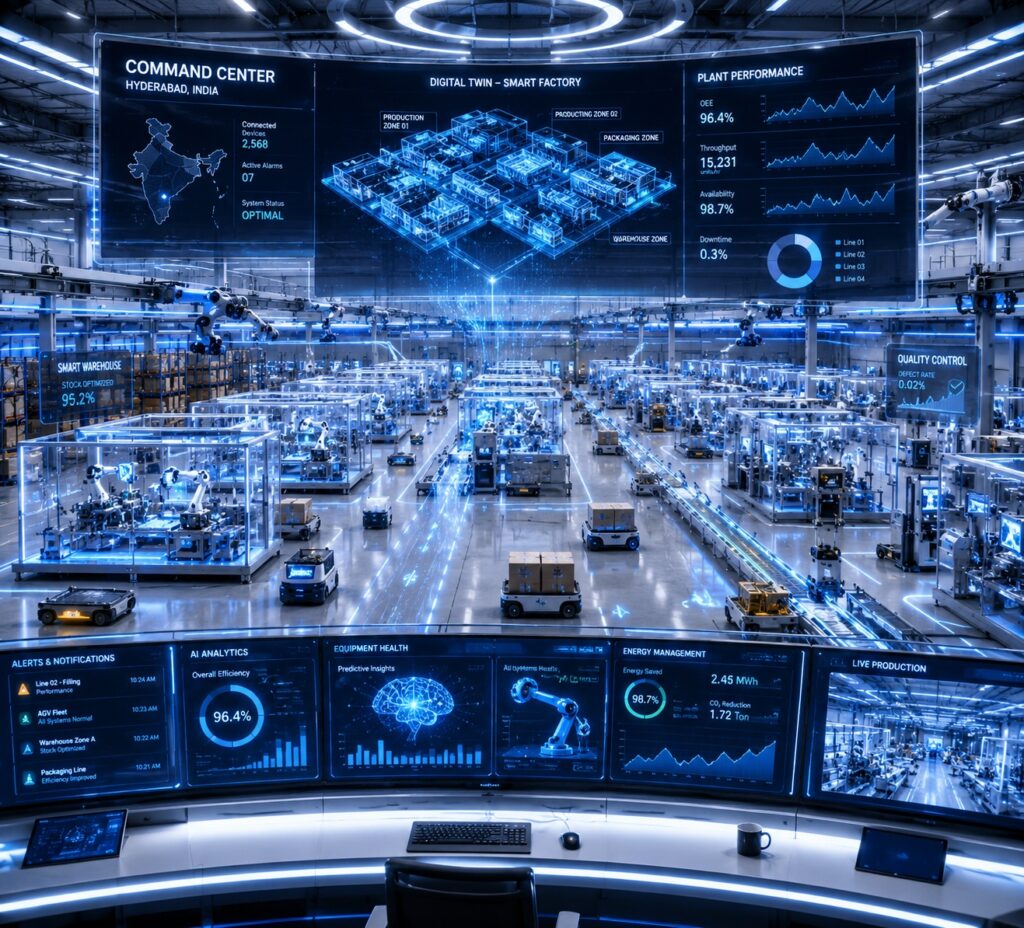
Hyderabad’s Evolution into a Technology-Driven Manufacturing City
While Hyderabad is globally recognized for pharmaceuticals and life sciences, it has also developed into a center for engineering innovation and industrial technology.
The city’s industrial landscape includes:
- Pharmaceutical production plants
- Medical device manufacturers
- Precision engineering companies
- Electronics assembly units
- Packaging equipment manufacturers
- Food and nutraceutical processing facilities
As these sectors expand, they require automation products that improve speed, traceability, and operational visibility. This growing ecosystem has fueled investment in integrated factory automation technologies capable of supporting diverse manufacturing requirements.
Beyond Machines: What Industrial Automation Really Means
Many people associate automation solely with robotic arms or conveyor belts. In reality, industrial automation is an interconnected system that synchronizes machines, software, sensors, and data to create intelligent workflows.
A modern automation environment can:
- Detect production anomalies automatically
- Monitor equipment health in real time
- Optimize production scheduling
- Reduce energy consumption
- Improve maintenance planning
- Generate live operational insights
These capabilities make intelligent manufacturing ecosystems increasingly valuable for businesses seeking long-term efficiency.
The Hidden Cost of Manual Manufacturing
Manual processes often introduce challenges that remain unnoticed until they impact profitability.
Examples include:
- Inconsistent product quality
- Rework and scrap generation
- Production bottlenecks
- Documentation errors
- Unplanned equipment downtime
- Variable operating procedures
Industrial automation addresses these issues by standardizing operations and enabling repeatable, measurable performance.
Organizations adopting data-driven manufacturing solutions often discover opportunities for significant productivity improvements.
Automation Products That Are Changing Modern Industries
Instead of relying on isolated machines, manufacturers are implementing comprehensive automation architectures that communicate seamlessly across departments.
Key technologies include:
Smart Controllers
Modern control systems coordinate multiple production stages simultaneously while maintaining accuracy and repeatability.
Industrial Sensors
Sensors continuously monitor pressure, temperature, speed, alignment, vibration, and product movement to ensure stable operation.
Vision-Based Inspection
AI-assisted imaging systems identify defects faster than manual inspection and support zero-defect manufacturing goals.
This has increased interest in machine vision inspection systems across pharmaceutical and industrial sectors.
Human-Centered Interfaces
User-friendly dashboards allow operators to visualize production metrics, monitor alarms, and optimize workflows without unnecessary complexity.
Connected Analytics Platforms
Cloud-enabled software transforms raw manufacturing data into meaningful business intelligence that supports informed decision-making.
Why Customization Is Becoming More Important Than Standardization
No two factories operate in exactly the same way. Product characteristics, space limitations, compliance requirements, and production goals vary significantly across industries.
As a result, businesses increasingly prefer customized automation solutions that align with their unique manufacturing environments.
Tailored systems provide:
- Better equipment utilization
- Simplified workflows
- Reduced integration challenges
- Improved return on investment
- Future expansion flexibility
This trend has accelerated demand for bespoke industrial automation products in Hyderabad.
The Growing Role of Automation in Pharmaceutical Innovation
Hyderabad’s pharmaceutical industry continues to pioneer advanced dosage forms, specialized packaging technologies, and precision manufacturing techniques.
Automation supports these innovations by improving:
- Process repeatability
- Inline quality verification
- Batch traceability
- Material handling
- Sterile production workflows
- Packaging consistency
Manufacturers increasingly depend on pharmaceutical process intelligence to maintain regulatory compliance while scaling production.
Sustainability Through Smart Automation
Automation is also helping industries reduce environmental impact.
Modern production systems optimize:
- Electricity consumption
- Material utilization
- Waste reduction
- Water management
- Equipment efficiency
These improvements contribute to both operational savings and sustainability goals, making energy-efficient manufacturing technologies an important area of investment.
Preparing for the Factory of the Future
The next generation of manufacturing will rely on predictive systems rather than reactive processes.
Emerging capabilities include:
- AI-assisted production planning
- Self-diagnosing equipment
- Digital twins
- Autonomous quality monitoring
- Collaborative robotics
- Remote plant management
Companies investing today are laying the groundwork for highly adaptive facilities capable of responding to changing customer demands with remarkable speed.
Why Hyderabad Businesses Are Accelerating Automation Investments
Organizations across Hyderabad recognize that automation is not simply about replacing manual work—it is about creating smarter businesses.
Key motivations include:
- Faster product launches
- Consistent manufacturing quality
- Reduced operational risks
- Better customer satisfaction
- Scalable production infrastructure
- Improved global competitiveness
These priorities continue driving adoption of future-ready manufacturing systems across the region.
Conclusion
Industrial automation products are reshaping how businesses design, operate, and optimize modern manufacturing facilities. Hyderabad’s growing reputation as a center for engineering excellence and pharmaceutical innovation makes it an ideal environment for adopting intelligent production technologies.
Rather than focusing solely on speed, today’s automation strategies emphasize connectivity, flexibility, sustainability, and data-driven decision-making. Companies that embrace these advancements can build more resilient operations, improve product quality, and position themselves for long-term success in an increasingly digital industrial landscape.