
In today’s era of digital transformation, industries are evolving faster than ever before. The key drivers of this evolution are Industrial Engineering and Automation — two disciplines that work hand in hand to improve efficiency, productivity, and quality across all sectors of manufacturing and production.
At iControl Technology machines, we believe that the integration of engineering expertise with smart automation systems is not just a competitive advantage — it’s the foundation of modern industry success.
1. What Is Industrial Engineering?
Industrial Engineering (IE) focuses on optimizing complex processes, systems, and organizations.
It involves designing workflows, improving efficiency, reducing waste, and ensuring high-quality output — all while maintaining safety and sustainability.
Industrial engineers apply principles of mathematics, physics, and human factors to create systems that make the best use of people, machines, materials, information, and energy.
2. The Shift Toward Industrial Automation
Industrial Automation takes these optimized processes and elevates them with the power of technology.
It replaces repetitive manual tasks with intelligent systems, such as sensors, robots, PLCs (Programmable Logic Controllers), SCADA (Supervisory Control and Data Acquisition), and AI-based control systems.
Automation allows industries to achieve:
- Higher productivity with minimal human error
- Improved quality and consistency
- Reduced operational costs
- Real-time process control and monitoring
- Increased worker safety in hazardous environments
3. The Synergy Between Engineering and Automation
Industrial Engineering and Automation complement each other perfectly.
While engineering focuses on process design and optimization, automation ensures those processes run with precision, repeatability, and control.
For example:
- Industrial engineers design the production flow of a factory.
- Automation engineers implement the control systems that make it run efficiently.
Together, they create smart factories capable of self-monitoring, adapting to demand, and minimizing downtime — key aspects of Industry 4.0.
4. Applications Across Modern Industries
The impact of Industrial Engineering and Automation can be seen across various sectors:
a. Pharmaceutical Manufacturing
Automation ensures accurate dosing, contamination control, and traceability, while industrial engineering streamlines process flow and validation.
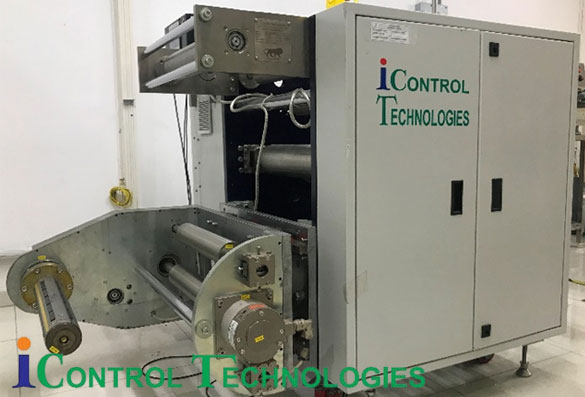
Example: iControl Technologies’ automated transdermal patch systems ensure precision, quality, and compliance in pharmaceutical production.
b. Food and Beverage Industry
Smart automation manages filling, packaging, and labeling with speed and hygiene, while industrial engineering reduces waste and ensures consistent product quality.
c. Automotive Industry
From robotic welding to automated assembly lines, automation paired with industrial engineering has revolutionized vehicle manufacturing — enhancing speed, precision, and safety.
d. Electronics & Semiconductor Industry
Highly automated, cleanroom-based processes ensure accuracy at the micro level, optimized through IE principles like lean manufacturing and Six Sigma.
5. Benefits of Integrating Engineering and Automation
When industries combine the strengths of engineering design with automated control, they gain measurable advantages:
- Efficiency Optimization: Streamlined workflows and minimal downtime.
- Cost Reduction: Lower labor and material waste.
- Consistent Quality: Precision-controlled manufacturing.
- Scalability: Systems that can grow with production demand.
- Data-Driven Decision Making: Real-time monitoring and predictive maintenance.
These benefits not only enhance productivity but also ensure sustainable and environmentally responsible manufacturing.
6. iControl Technologies: Engineering Excellence with Intelligent Automation
At iControl Technology machines, we bring together industrial engineering expertise and automation innovation to deliver customized solutions for modern manufacturing.
Our systems are designed to meet international standards, providing:
- PLC and SCADA-based automation
- Precision motion control systems
- Vision-based inspection and quality control
- Industry 4.0 and IoT-enabled monitoring
- Turnkey machinery design and integration
We serve diverse industries including pharmaceuticals, packaging, food processing, and specialty manufacturing — helping clients achieve smarter, faster, and more reliable operations.
7. The Future: Industry 4.0 and Beyond
The next phase of industrial transformation — Industry 4.0 — integrates automation with AI, data analytics, and IoT (Internet of Things).
Future factories will be connected, intelligent, and autonomous, where machines communicate, learn, and make decisions in real time.
At iControl Technologies, we are continuously innovating to bring this future closer — empowering industries with smart automation solutions that drive growth, sustainability, and performance excellence.
Conclusion
Industrial Engineering and Automation are the twin pillars of modern industry.
While engineering provides the foundation for process excellence, automation ensures those processes run flawlessly — 24/7.
At iControl Technologies, our mission is to blend engineering precision with intelligent control, creating solutions that deliver measurable results and long-term value.
🔹 Partner with iControl Technologies
For customized automation and industrial engineering solutions, visit www.icontroltech.in
Let’s shape the future of smart manufacturing — together.